
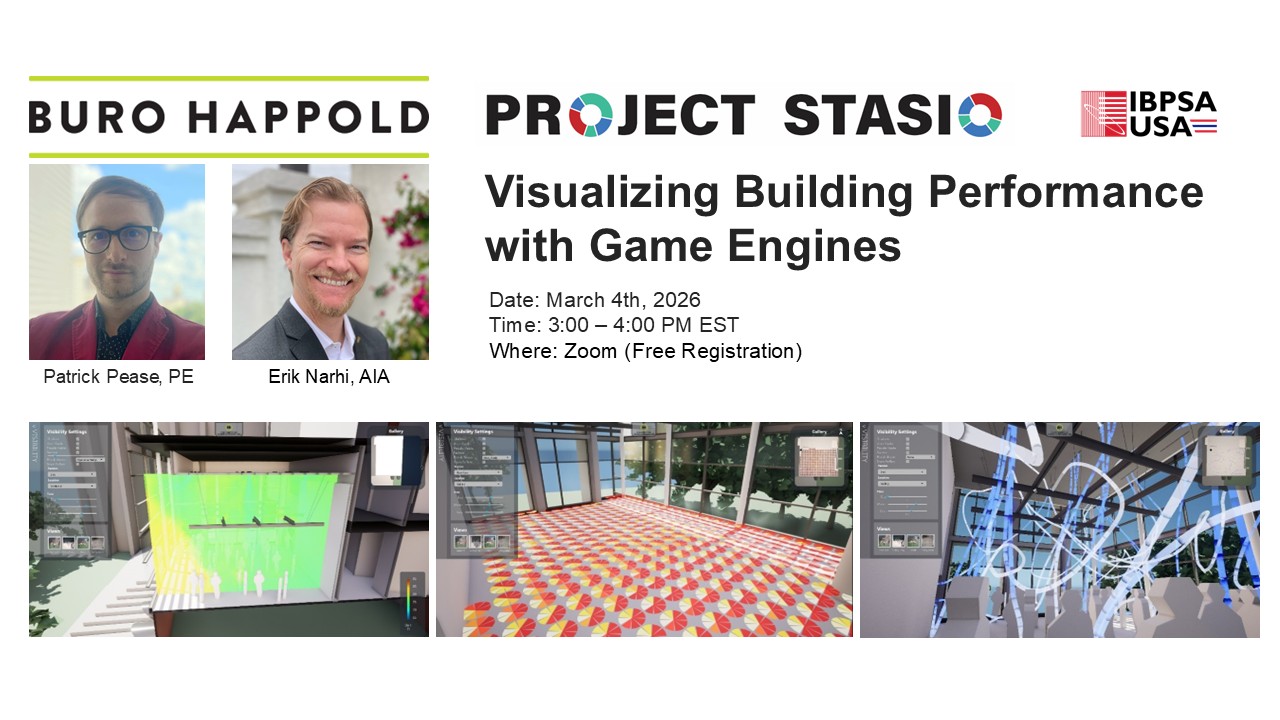
Project StaSIO Webinar: Visualizing Building Performance with Game Engines
Game engine technology is helping to transform building design and the way we understand simulations. The session will highlight how real-time simulation and immersive visualization can improve decision-making, explore design trade-offs, and elevate project outcomes through practical examples.

Patrick Pease
Associate Principal | Building Performance Leader
Patrick serves as an Associate Principal and Building Performance Service Leader in Buro Happold’s Boston office.
An innovator in design and simulation processes, Patrick uses technology to deliver high-quality results and drive collaboration on projects. His past projects include both high-performance design for complex projects – such as the Living Building Challenge Climate Exchange campus – and innovative solutions to building performance simulation.
As a mechanical engineer and energy modeler for over a decade, Patrick has worked in the across the US and EU on an array of hospitality, commercial, higher education, laboratory, and healthcare building and campus developments.
His passion for innovation and quality has included the creation of a wholly new energy modeling platform and publishing 5 papers at industry conferences. As an active member of ASHRAE and IBPSA, Patrick sits on the 90.1 ECB sub-committee and is a voting member of ASHRAE SSPC 209 and the IBPSA Practitioner Committee.

Erik Narhi
Computational Design Lead
Erik Narhi is an Architect working at the intersection of computation, design, and engineering. He leads the US Specialist Analytics Team, applying innovative approaches to People Comfort and People Flow analysis to deliver high-performance outcomes on complex projects. In addition to his work leading the Analytics Team, he leads Game Engine Adoption and Specialists Computational Development for the Practice.
Erik leads a multidisciplinary team of computationally driven professionals who harness emerging technologies across computer science, architecture, engineering, and game development to revolutionize how buildings are designed, analyzed, and delivered. He approaches each project through this lens—aligning cutting-edge processes and deep technical expertise with project goals to achieve meaningful client outcomes.
Erik has presented his work on computational design in the AEC industry at numerous events, including Autodesk University, Tech+, AEC Tech and The BIM Symposium, and was a recipient of the TAP AIA Innovation Award for his work with a multidisciplinary team developing the open-source BHoM LCA Toolkit. He has also taught and advised students at universities including Stanford, USC, Columbia and MIT, guiding the application of innovative techniques and technologies to transform design and construction processes.
