

Dear Load Manager,
Flexible Buildings Need Flexible People
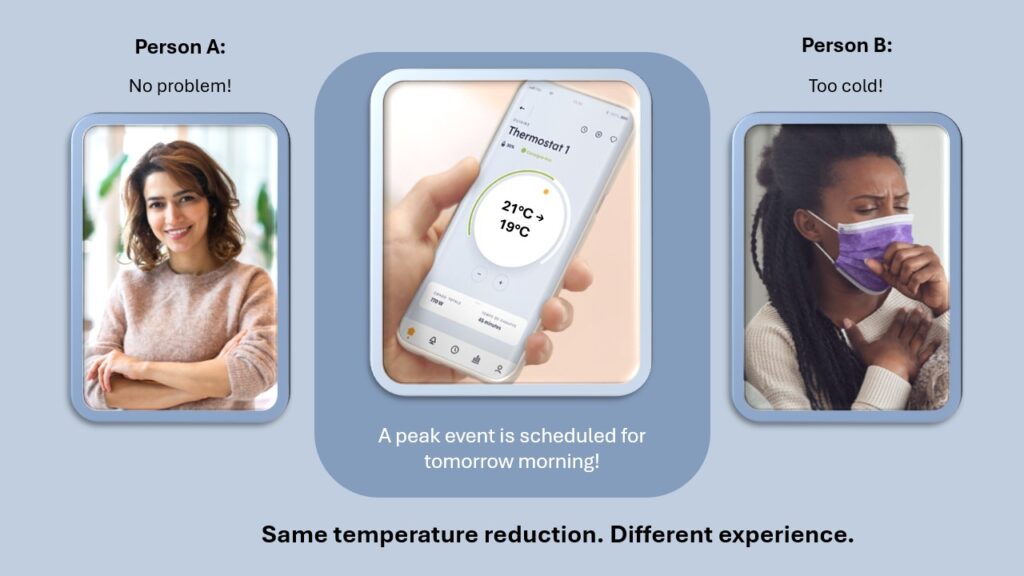
Imagine two neighbors participating in the same demand response event. Their thermostats are both lowered by 2°C (about 4°F) during a winter peak period. One never notices. The other immediately overrides the setting and wonders whether to leave the program altogether.
The difference isn’t the house. It’s the occupant.
While demand response can involve many flexible resources—from electric vehicle charging to water heating—residential HVAC systems are among the most common and high-impact demand response resources. As a result, occupant comfort often becomes a central consideration when designing and evaluating these programs.
For years, demand response programs have focused on the flexibility of buildings and appliances. Researchers have developed increasingly sophisticated strategies to reduce energy demand during periods of high grid demand, often demonstrating peak-load reductions of 20–30% in simulation studies. Yet despite this technical potential, the amount of demand response capacity in electricity markets remains relatively small.
The challenge is no longer proving that demand response can work—the challenge is designing programs that people actually want to participate in.
Comfort for Whom?
Many residential demand response programs still rely on a one-size-fits-all approach. A thermostat setback that is barely noticeable for one household may be unacceptable for another.
In reality, comfort is highly personal and influenced by:
- Individual temperature preferences
- Daily schedules and occupancy patterns
- Age, gender, and other demographic factors
- Housing characteristics and building performance
- Financial circumstances and energy costs
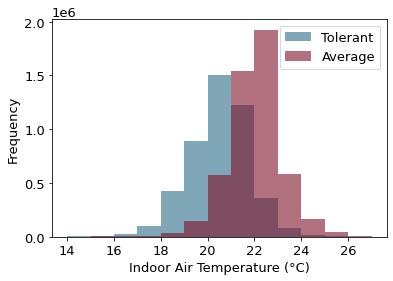
Figure: Distribution of indoor temperatures observed for two distinct occupant groups during the winter heating season in Quebec. The differences illustrate the range of temperature preferences observed across households (Kaspar et al., 2024).
Importantly, a lower thermostat setting in winter does not necessarily indicate greater tolerance for cold temperatures. Some occupants may maintain lower temperatures because they genuinely prefer them, while others may be trying to reduce their energy bills. Treating these households as equally “flexible” can lead to incorrect assumptions about both comfort and demand response potential, highlighting the importance of understanding not only individual comfort preferences, but also the factors that drive occupant behavior.
What Makes a Successful Demand Response Program?
Discomfort is one of the biggest barriers to long-term participation in demand response programs.
Enrollment is often treated as the primary measure of success, but enrollment is only the first step. A successful program is one in which participants:
- Remain enrolled over time
- Feel comfortable during demand response events
- Retain the ability to override controls when needed
- Continue participating in future events
Importantly, maintaining occupant comfort does not necessarily mean sacrificing energy savings. Rather, it requires demand response strategies that recognize and accommodate differences in occupant preferences, behaviors, and circumstances. The solution is not necessarily more overrides, more incentives, or more control—it is a better understanding of occupants.
Designing for Real People, Not Ideal Ones
Recognizing different comfort preferences can improve the balance between energy savings and thermal comfort in three important ways.
- Know your occupants, then act accordingly.
Rather than applying the same thermostat adjustment to every home, programs can tailor actions based on observed behavior and preferences. A tiered participation structure makes this practical—occupants self-select into the level of intervention they’re comfortable with, and homes that tolerate larger setbacks provide greater flexibility while more sensitive households receive smaller ones. The program captures real flexibility from those who have it, rather than assuming it from everyone.
2. Target the right homes at the right time.
Not every home needs to participate in every event at the same intensity. On the coldest days, when comfort thresholds are most likely to be tested, programs could reduce the depth of setbacks or prioritize homes with historically tolerant occupants. Smarter targeting shifts load where it costs occupants the least—and produces savings that are more realistic and more reliable than a blanket approach.
3. Protect comfort to protect participation.
A slightly smaller load reduction today may be worthwhile if it helps retain participants for years to come. Occupants who feel comfortable and respected are more likely to trust the program, remain enrolled, and continue providing flexibility when it is needed.
Redefining Success
The goal of demand response should not be to maximize load reduction during a single event. The goal should be creating a program that people are willing to participate in repeatedly, which delivers the most significant long-term benefits to the electrical grid.
Recognizing occupant comfort preferences shifts demand response from a technology problem to a human one. The most valuable flexibility resource in a home may not be the thermostat itself, but the occupant’s willingness to provide flexibility.
The future of demand response depends less on finding flexible appliances and more on understanding flexible people.
Reference
Kaspar, K. E., Ouf, M. M., & Eicker, U. (2024). Data-driven occupant-thermostat override models for winter heating in Quebec. In Proceedings of SimBuild Conference 2024, vol. 11. IBPSA-USA Building Simulation Conference. IBPSA-USA (pp. 725-734). IBPSA-USA Denver, Colorado.

Kathryn Kaspar, PhD
Concordia University
Kathryn Kaspar completed her Ph.D. in Building Engineering at Concordia University in 2026, with research focused on demand-side energy management in residential neighborhoods considering varied occupant behaviors and preferences. With a background in civil and structural engineering, her work has spanned sustainable reconstruction, urban energy planning, and building energy management. She is currently completing a Mitacs placement with vadiMAP, where she contributes to the development of an AI-powered platform that transforms commercial building energy data into actionable recommendations for energy efficiency, cost reductions, and renewable energy integration.
