

What Could the Future of 3D Building Printing Look Like?
-New Tech Family
Dear New Tech Family,
As you might have noticed in the media, technologies for 3D building printing have received considerable attention over the past ten years for their potential to revolutionize design freedom, construction speed, labor efficiency, and affordability. Currently, there are hundreds of 3D-printed buildings worldwide, predominantly residential projects. Although this number is large enough to demonstrate the technology, it represents an infinitesimal fraction of the global building stock. Through these experimental projects, we have seen the opportunities offered by 3D building printing and realized that many challenges lie ahead.
Opportunities
History has provided us with plenty of positive examples, from steam-powered looms to robots in computer-chip manufacturing, demonstrating that automation can create numerous new opportunities. I think 3D building printing is no exception.
- Design freedom – 3D printing curvilinear walls with articulated textures and patterns can be nearly as easy as constructing a plain vertical wall, e.g., De Vergaderfabriek, a one-story building with vertically curved walls, by CyBe [1].
- Construction speed – 3D-printed buildings can be constructed more quickly depending on the reference baseline. For large, multi-story buildings, dry assembly can be faster because it does not require waiting for wet materials at lower layers to cure, as 3D printing has to.
- Labor efficiency – 3D printing may require fewer workers as the technology matures, as demonstrated by the Origin Homes built by Apis Core [2], with the caveat that those workers need to be specialized in digital fabrication.
- Waste reduction – 3D printing does not require formwork, potentially resulting in less construction waste.
- Affordability – Many sources claim that 3D printing can be substantially more affordable, with a 55 m2 (600 ft2) home at $4,000 [3]. ICON Homes has sold 117 homes [4], and the Genesis Collection at Wolf Ranch, located in Georgetown, TX, is currently listed for about $500K [5]. In my opinion, an impartial data analysis is needed to determine how generalizable the affordability of 3D-printed homes is.
Challenges
Despite its rosy future, 3D building printing faces many challenges, which can be broadly classified into three categories: technology, market, and standardization. The unsuccessful 3D-printed houses in Cairo, IL and Muscatine, IA demonstrated that 3D building printing is more than a push of a button.
1. Technological Challenges
The technologies for 3D printing using polymers (PLA, resin, etc.) have advanced rapidly, while their costs have become affordable for the general public. 3D building printing has “borrowed” technologies from thermoplastic printing. However, the differences in materials, scale, and complexity for printing buildings have posed much greater challenges than printing a PLA model.
Concrete is the most commonly used material for 3D building printing, while other materials, such as clay, polymers, and bio-based composites, are also being explored. While researchers and designers actively search for solutions, primary challenges in using concrete as a printing material still remain. These include a lack of flexural and shear strength; thermal bridges when exterior layers connect to interior layers around openings (Figure 1); material engineering for printability (pumpability, extrudability, and buildability), interlayer bonding, and curing time; limited lean angles; and the high carbon emissions associated with cementitious materials. To elaborate, when a concrete recipe engineered for 3D printing requires a 17% water-to-dry-material mix ratio, a mix with even slightly lower water ratio (e.g., <16%) increases viscosity, which can impede continuous material deposition through the nozzle (i.e., lack of extrudability; imagine squeezing crystallized honey through a small hole, emerging as discontinuous segments). A drier mix can also cause hose blockage, i.e., poor pumpability. Conversely, a mix with a slightly higher water ratio (e.g., >18%) can make the mixture too fluid and susceptible to deformation, causing the lower layers to spread, buckle, or even collapse due to the weight of the upper layers (i.e., lack of buildability). 3D concrete printing is much finickier than the conventional cast-in-place method and requires careful material engineering, consistency of the mixer, controlled water temperature, and stringent control of many other factors. Using non-cement-based materials, such as clay, polymers, or bio-based materials, presents different challenges in ensuring that they can withstand the test of time and harsh outdoor environments.
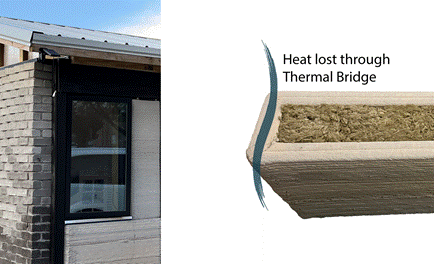
Figure 1. Thermal bridge at the edge of openings.
Simulation and modeling of 3D-printed buildings heavily rely on experimental data on the structural and thermal properties of the materials. However, the lack of comprehensive databases regarding material properties poses a fundamental challenge for simulating 3D-printed buildings. Conventional material databases may not accurately represent the actual behavior of 3D-printed materials because of their anisotropic properties and the difficulty of simulating reinforcement. Moreover, modeling the structural behavior of walls during printing is much more difficult because walls made of fresh concrete without formwork are vulnerable to buckling (Figure 2), especially when vertically curved. Even with sufficiently comprehensive material-property databases, simulation models for 3D printing buildings still require rigorous experimental validation.
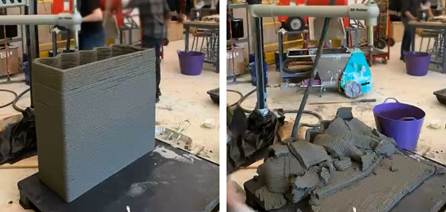
Figure 2. 3D-printed wall segment (left) buckled under load (right).
The vast majority of 3D-printed buildings focus on the walls. Other building components, such as roofs, slabs, foundations, basements (if any), insulation (Figure 3), MEP systems, windows, doors, and others, are constructed using conventional techniques. As the building gets larger or the slope of the site becomes steeper, simply printing the walls becomes exponentially more difficult. Looking globally, e.g., in many Asian countries where the majority of the global population lives, high-rise buildings are more common, while the sites for low-rise buildings can be too constrained to accommodate the printing equipment.
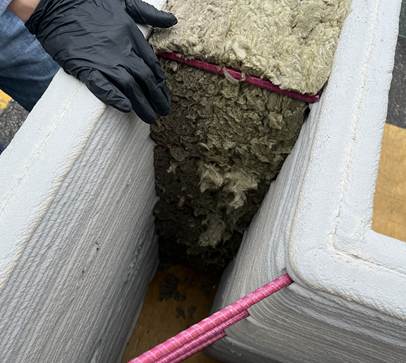
Figure 3. The bracing rods (pink fiberglass rebars) were inserted manually during the printing process, while the insulation layer was manually inserted after the concrete layers were cured.
2. Crossing the Chasm
Throughout history, many new technologies have failed to “cross the chasm,” exhausting their early adopters while the mass market remained out of reach. 3D building printing not only has to compete with conventional steel structures, cast-in-place and precast concrete, masonry, and light wood framing, but also with newcomers such as mass timber and foldable houses that target affordability or sustainability. The headwinds facing 3D building printing in the market also come from the mostly proprietary printable materials and the need for a specialized labor force.
3. Standardization
As 3D building printing technologies rapidly advance, the lack of widely accepted standards for printable concrete mixtures, structural performance, quality control, and construction safety and processes remains a barrier to broader adoption. Conventional construction benefits from well-established codes and testing procedures, while 3D-printed buildings often require project-specific approaches. Standardization would be an essential step toward making 3D building printing a reliable construction method that can be consistently designed, permitted, and accepted by the general public.
Summary
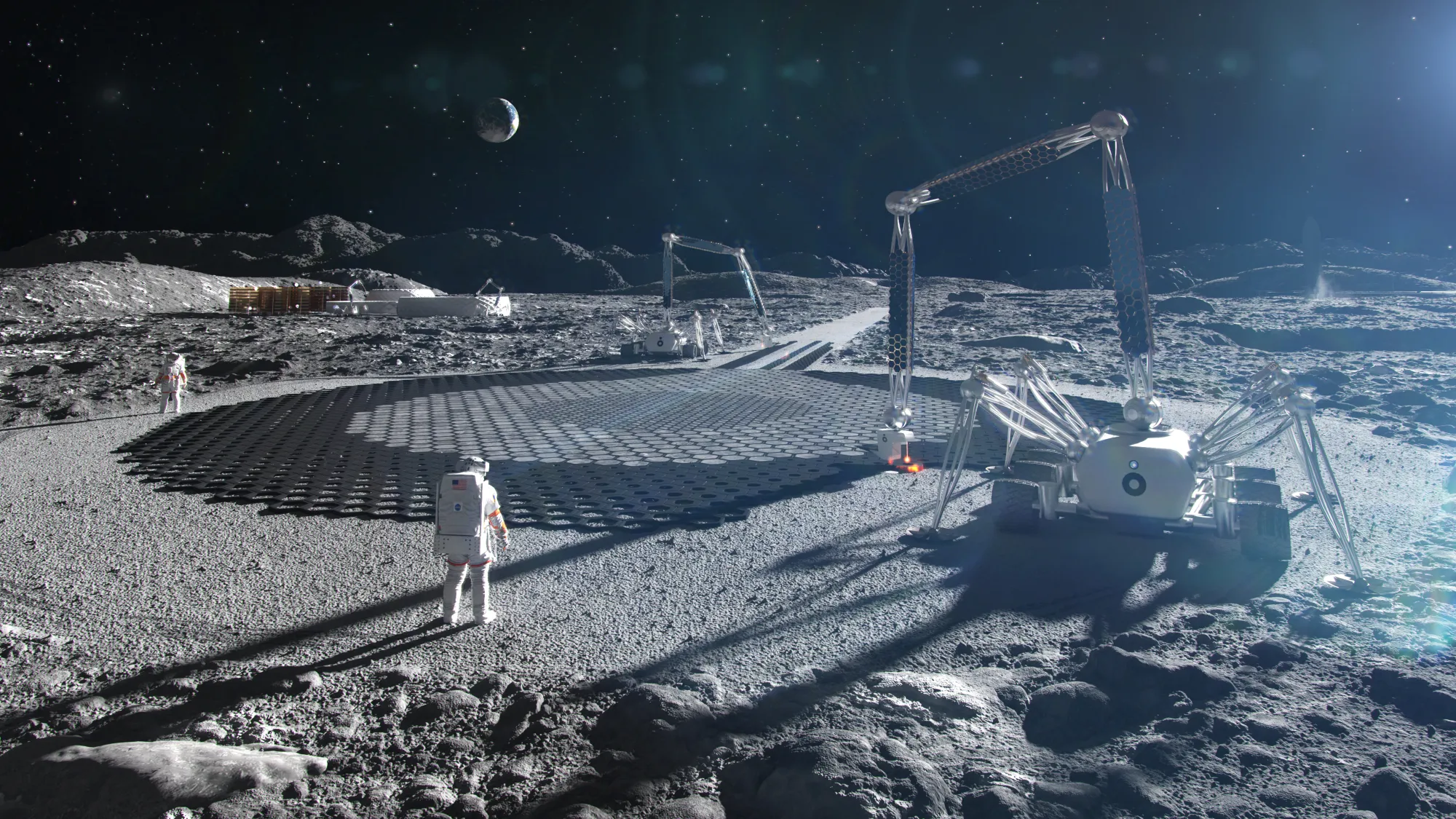
I don’t have a magic 8-ball to decisively tell what the future of 3D building printing will look like, nor do I want to flip a coin to “predict” the future. With that said, in my opinion, we may continue to see partially 3D-printed, small-scale buildings in the media, but fully 3D-printed buildings are unlikely to become mainstream in the foreseeable future, as wood framing, steel, and cast-in-place concrete have. We should objectively evaluate the challenges and limitations of 3D building printing technologies without being overly optimistic. More importantly, I urge us to push the limits of these burgeoning 3D building printing technologies, free of bias, to fully explore their capabilities and find a suitable place in architecture, whether on Earth or on the Moon.

References
[1]. De Vergaderfabriek by CyBe. https://cybe.eu/cases/de-vergaderfabriek/
[2]. Origin Homes by Apis Core. https://homes.apis-cor.com/
[3]. $4000 3D-printed home. https://www.3dnatives.com/en/icon-raises-9-million-to-create-affordable-3d-printed-houses-061120184/#!
[4]. ICON Homes. https://www.iconbuild.com/design-build
[5]. Genesis Collection at Wolf Ranch. https://www.lennar.com/new-homes/texas/austin-central-texas/georgetown/wolf-ranch/genesis-collection
Image credit: ICON/BIG-Bjarke Ingels Group. Olympus project at NASA, 2022-2026