
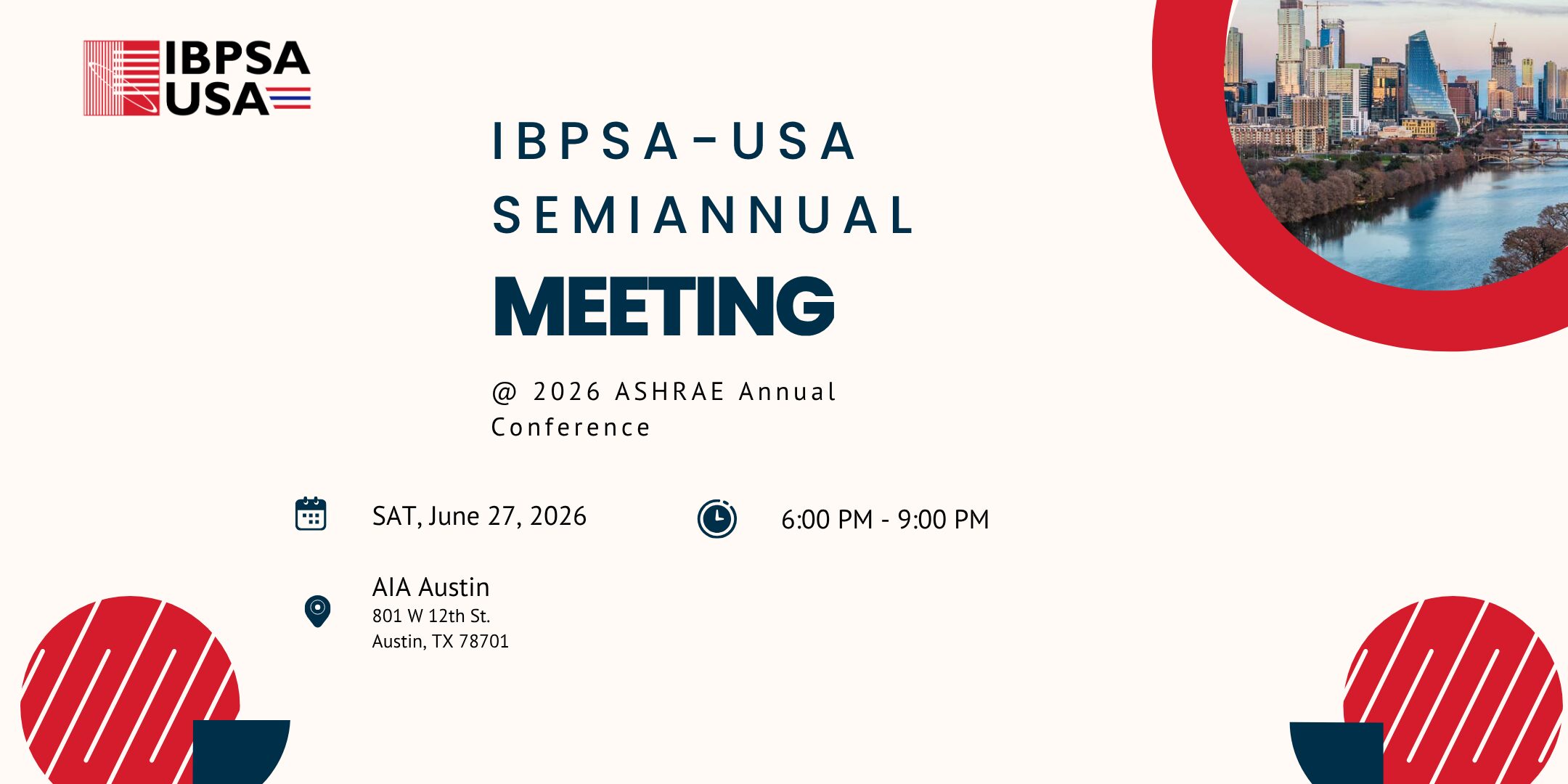
IBPSA-USA 2026 Semi-Annual Meeting
The IBPSA-USA Semi-Annual Meeting brings together members of the building performance simulation community for an open exchange of ideas and updates. Whether you’re an experienced practitioner or just beginning to explore the field, the meeting offers a chance to connect with peers, learn about current IBPSA-USA initiatives, and hear what’s coming up next.
The program includes time to meet with software vendors and developers, learn about new tools, and discuss practical approaches to simulation. It’s also a good opportunity to engage with students, emerging professionals, and colleagues from around the country in a relaxed, social setting.
Held just before the ASHRAE Annual Conference, the meeting includes appetizers and drink tickets to support informal networking. We look forward to seeing you there!
Presentation 1: Modeling and Challenges of Community Microgrids: Power Generation, District Systems, and Energy Storage
As communities pursue decarbonization, integrating distributed energy resources —including renewable generation, district energy systems, thermal storage, and combined heat and power —offers a pathway to improve resilience, reduce emissions, and support grid reliability. However, realizing these benefits requires integrated modeling and control strategies that capture interactions across multiple energy systems.
Using the University of Texas at Austin campus microgrid as a testbed, this work developed both physics-based simulation models and reduced-order optimization models. Results showed that integrating renewables could reduce campus emissions by 45%, while also highlighting the limitations of renewable-only pathways to net zero. Additional studies demonstrated that optimized control of chilled water plants and thermal energy storage reduced electrical peak demand by 5–8% and cooling energy use by 1.6%. Simulations of district heating system upgrades and thermal storage integration yielded further energy savings. Overall, the work presents a scalable framework for modeling and optimizing integrated community energy systems.

Presentation 2: Building Performance by Design: Integrating Energy Modeling into the Design Process
As energy codes, sustainability goals, and owner -expectations continue to evolve, design teams are increasingly being asked to make performance -driven decisions earlier and faster than before. This presentation will explore the reasons behind Parkhill’s creation of a dedicated Building Performance team and how the firm’s interdisciplinary design process approaches whole-building energy modeling and performance-based decision making throughout multiple phases of design.
Included will be insights on software comparisons, integrating analysis into real project timelines , and lessons learned while implementing building performance workflows within a multidisciplinary practice. The presentation will also discuss the need for practical and adaptable approaches to high-performance design specifically in challenging regions like West Texas. Through project experiences and workflow examples, the presentation will demonstrate how building performance analysis can become a meaningful conversation in the design process rather than a standalone sustainability exercise.

Melanie Canfield, LEED Green Associate
Melanie Canfield serves as a Building Performance Analyst at Parkhill with specialized experience in high-performance building consulting. Her LEED Green Associate and FEMA Infrastructure Disaster Management certifications complement her commitment to creating resilient, sustainable environments through innovative solutions. She currently serves as the High-Performance Building Office Leader and ASHRAE Refrigeration/Sustainability Chair for the Austin Chapter.

Eeshana Hamed, LEED Green Associate, CEM
Eeshana Hamed currently serves as a Building Performance Analyst at Parkhill with a focus on building energy efficiency and data-driven analyses. As a Certified Energy Manager (CEM) and LEED Green Associate, she is committed to the advancement of sustainable practices in high performance building design and energy efficient strategies.
Support a Student! We’re offering an option to sponsor students for just $20, helping them gain valuable industry insights and make connections within the IBPSA-USA community. It’s a small contribution that makes a big difference for emerging professionals – simply select the sponsorship option when you RSVP if you’d like to participate.
