

What are the most significant advantages of integrated control strategies over local controls for heat pump and PV system performance?
-Building Optimizer
Dear building optimizer,
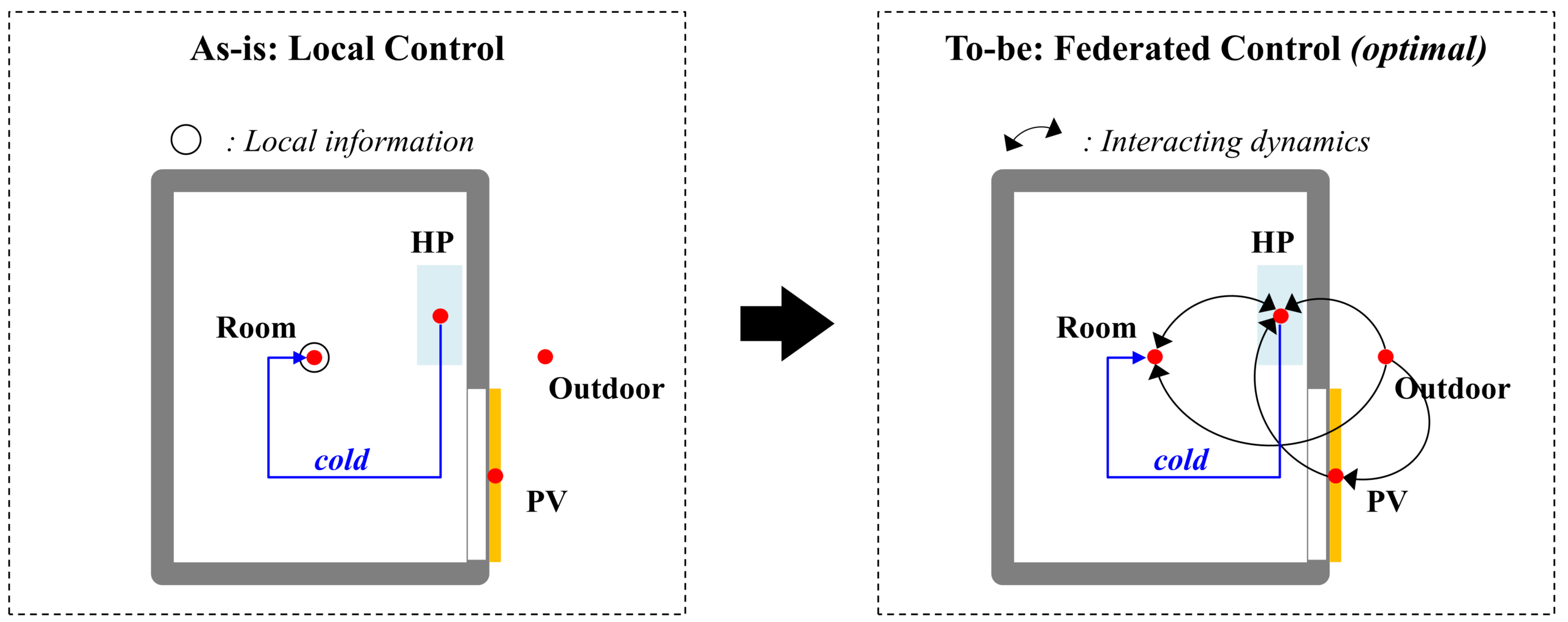
When controlling building systems, relying solely on local, real-time information is common practice, but it severely limits efficiency. This approach is like driving your own car while looking only at the road ahead of the bumper, rather than having an integrated system that coordinates future fuel supply, route demand, and traffic conditions to plan the most efficient acceleration and gear shifts. The car will reach the destination eventually, but its route may not be optimal.
The “local” control strategy operates with tunnel vision. For example, local zone cooling control reacts exclusively to the current indoor air temperature (IAT) based on a predefined setpoint rule. It has no awareness of a building’s heat storage capacity, weather forecast, non-linear dynamics of the heat pumps (HP), or predicted electricity generation from the photovoltaic (PV) panels. This can prevent the system from maximizing its net energy efficiency.
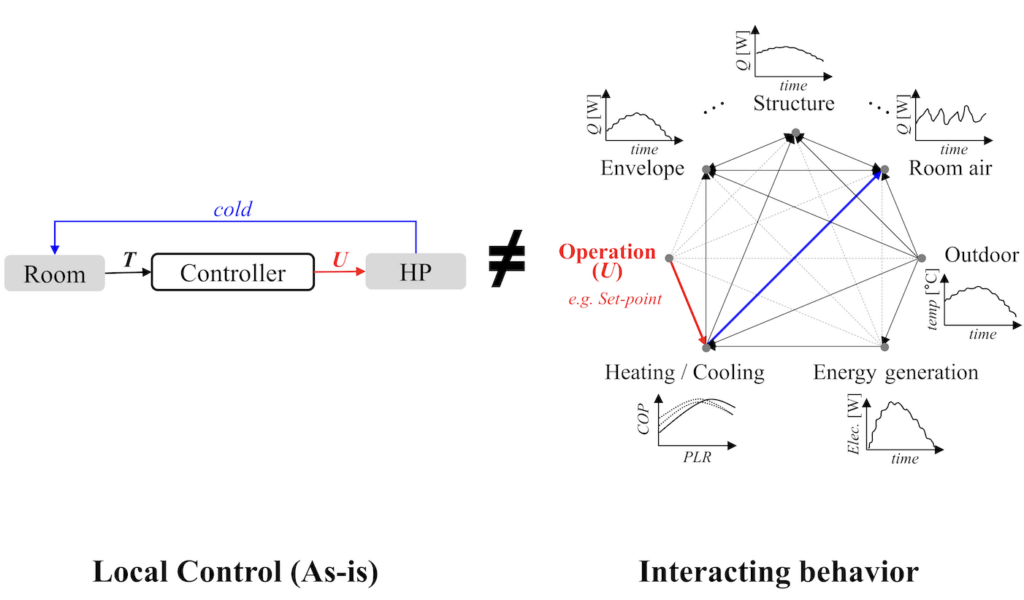
To maximize the energy-saving potential of coupled technologies like HPs and PVs, we need a “federated” (or integrated) control strategy. The core of this strategy is to capture the complex interplay between the outdoor environment, the thermal zone, and the equipment. By predicting how these factors work together, the model acts as the intelligence that drives the Model Predictive Control (MPC) engine. This engine uses these predictions to calculate and determine the most energy-efficient way to operate the HP in real-time.
The first significant advantage is the shift from reactive corrections (reacting to past changes) to predictive optimization (acting on future forecasts). A federated MPC uses predictive models—in our study, three interconnected Artificial Neural Networks (ANNs)—to forecast the future states of the thermal zone, the HP’s energy consumption, and the PV’s electricity generation over a given time horizon. This allows the controller to exploit favorable conditions before they happen. For example, on a morning with high solar radiation, our federated controller predicted the peak PV generation and strategically pre-cooled the space by lowering the setpoint. This effectively used the free solar electricity to store coolness in the building’s thermal mass, significantly reducing the need for grid-supplied energy later in the day. The local control, by contrast, simply missed this opportunity, waiting until the room was already hot to react – at which point it had to pull additional power from the grid.
The second key advantage is the intelligent modulation of the HP’s Part-Load Ratio (PLR). HPs are variable-speed machines capable of subtle modulation. However, local controls often force these sophisticated machines to act like blunt instruments. Relying on predefined rules—such as turning on only when the temperature exceeds a set limit—effectively reduces a variable-speed unit to a binary ‘on/off’ device. This creates an inefficient operating pattern that completely ignores the hardware’s ability to run continuously at partial loads. A federated controller, however, understands the non-linear dynamics of the HP and utilizes its full operational range intelligently. In our real-world test, during a high-cooling-load, low-PV-generation afternoon, the federated control employed a clever strategy: it circulated indoor air through the Direct Expansion (DX) coil without resorting to HP cooling operation (i.e., the compressor was off). This put the system into a minimum power mode—just enough to delay the IAT rise—drawing such minimal power (e.g., <100W) that it was completely offset by the low PV generation. It effectively maintained comfort at near-zero net energy consumption, a nuanced strategy a blind local controller cannot replicate.
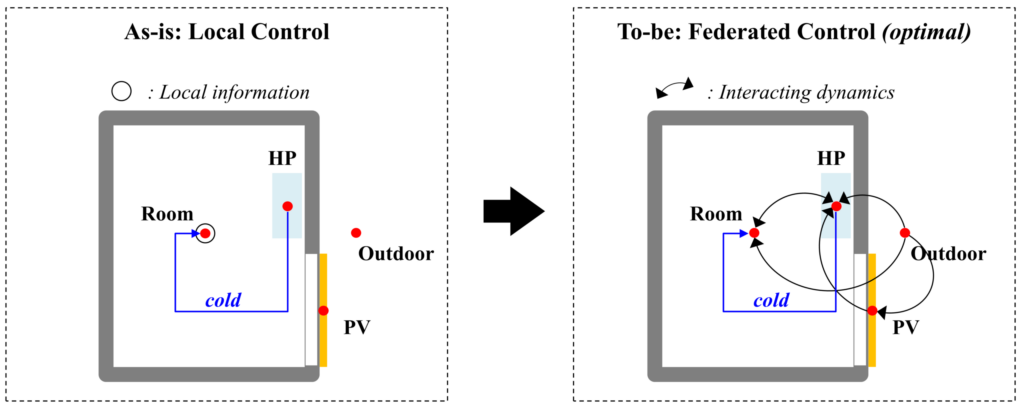
Local vs Federated control for zone-HP-PV system
In our week-long, real-life implementation for a 40m2 room, the federated control achieved a net energy saving of 40.4% compared to the local control (local: 7,138 Wh vs. federated: 4,254 Wh). However, the lesson here goes far beyond just HP and PV systems.
Mun, J., Cho, S., Choi, S. and Park, C.S. (2024), Local vs. federated cooling control for an office space with heat pump and photovoltaic systems, Energy and Buildings, Vol 321, 15 October, 114631 (https://doi.org/10.1016/j.enbuild.2024.114631)
The fundamental advantage of the federated strategy is its capability to recognize, and therefore optimize, these complete, interwoven dynamics. By moving away from compartmentalized control actions, the system can make decisions that are globally optimal for net energy consumption, rather than being locally sub-optimal. This concept is essential as the building industry shifts toward net-zero targets. The federated control philosophy is broadly applicable to a variety of building energy systems in daily practice.